














FUEN launches new project for the minorities in Bijeljina, Bosnia and Herzegovina
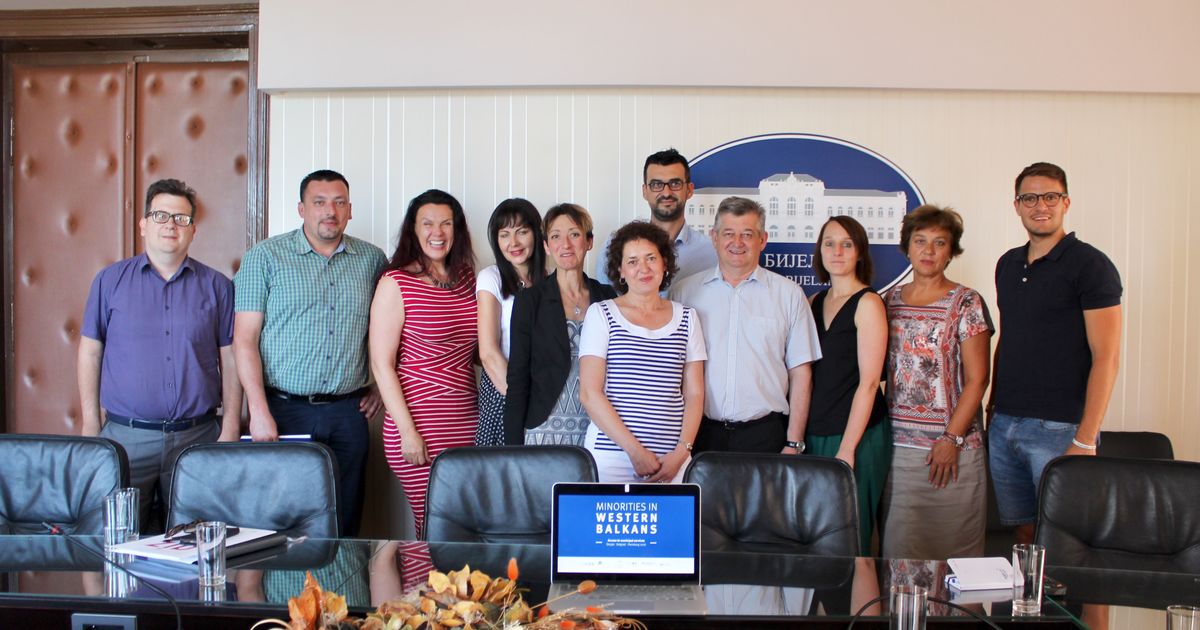
05.07.2017We are pleased to announce a successful kick-off of a new project in Bijeljina, BiH. After the project “Minorities in Western Balkans” finished last year, the project partners received the trust and support from the German Federal Ministry for Economic cooperation and development (BMZ) and the State Chancellery of Schleswig-Holstein in collaboration with the GIZ to continue the project in 2017. As a follow up several sub-projects were developed by our local partners, with the support and experience of FUEN and ECMI.
The project called “Establishing an office of a minority commissioner”, which was launched on Wednesday the 5th of July in Bijeljina, BiH, aims to provide an office for national minorities at the local level, based on the experience of the state of Schleswig-Holstein. In Bijeljina the largest minority are the Roma, followed by the Slovak minority. Together with our local partners NGO Otaharin, the Municipality of Bijeljina and the Bijeljina Social centre, we will develop a project plan and a time line until the end of the year. This includes a series of consultations over the summer, a study trip to Schleswig-Holstein in September, including a seminar for the representatives of the local administration and NGOs, as well as a one-day official opening of the office in November. The project plan was presented to the Mayor of Bijeljina, Mr. Mićo Mićić, who expressed his personal support and commitment of the Municipality to the project.
We are looking forward to a fruitful cooperation with all the project partners and experts.
- Here you can watch a documentary movie about the Western Balkans project.
- Here you can read more about the projects developed with the ECMI
Background:
Vulnerable minority groups are the focus of the project “Minorities in Western Balkans” launched by the State Chancellery of Schleswig Holstein in cooperation with GIZ (Deutsche Gesellschaft für Internationale Zusammenarbeit) and financed by the German Federal Ministry for economic cooperation and development (BMZ). The project implementation partners are the FUEN (Federal Union of European Nationalities) and the ECMI (European Centre for Minority Issues), both of them actively involved in sharing Schleswig-Holstein’s experiences of minority protection to the target groups. The first project edition was successfully implemented already in 2016 with the aim to introduce the Schleswig-Holstein model to the local actors in the Western Balkans and to increase access of Roma to municipal services. After the first training in the Balkans, FUEN organized the Study Trip to the German-Danish border region, where the participants had the chance to exchange with the locals. The direct target groups of the project are members of the (pro-) Roma NGOs and local governments in Serbia, Macedonia, BiH and Kosovo.
COMMUNIQUÉ DE PRESSE
- 8th Annual Meeting of the FUEN Working Group on Education: vocational education, minority languages and AI in focus
- FUEN discussed minority issues with EU institutions in Brussels
- FUEN exhibition opens at the European Parliament: putting minority languages on the European agenda
- FUEN Working Group on Education meets in Eupen: Focus on vocational education, minority languages and AI
- FUEN Assembly of Delegates 2026 calls for greater inclusion of minority languages in artificial intelligence
- FUEN Congress discusses geo-blocking and the protection of minority languages
- FUEN Congress Examines Mother-Tongue Access in Healthcare and Social Services
- FUEN Congress Spotlights the Future of Minority Languages in Public-Service Broadcasting
- 70th FUEN Congress opens in Helsinki/Helsingfors
- For Protection of the Cultural Identity: The Case of the Breton Community in France