















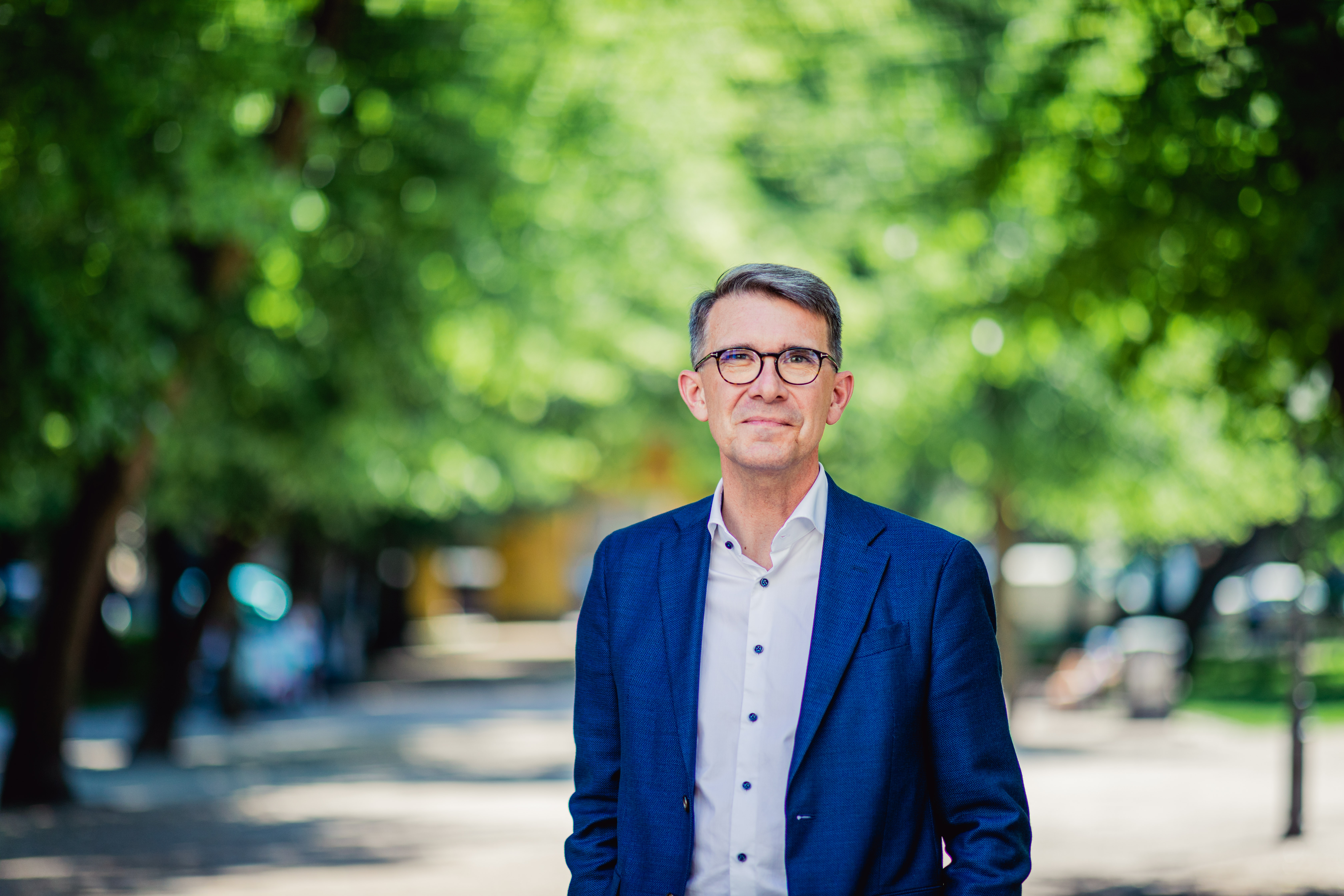
Björn Teir: What we do not digitize today is not visible to the world tomorrow
13.10.2026As technological advancement continues to reshape global communication and knowledge sharing, the preservation of minority languages and cultural identity faces unprecedented opportunities and risks. To address these vital dynamics, the 10th Forum of European Minority Regions will take place on 23 October 2026 in Chur / Cuira / Coira (Switzerland).
Centering around the theme "Minorities and Artificial Intelligence – Risks and Promises," this landmark edition of the Forum will gather regional leaders, researchers, cultural workers, and minority advocates from across Europe. Discussions will focus on how emerging digital tools and Large Language Models (LLMs) impact lesser-used languages, the structural challenges of digital representation, and strategies to ensure minority heritage thrives alongside rapidly evolving technologies.
Among the key voices participating in this year's dialogue is Björn Teir, Secretary General of Svenska Litteratursällskapat i Finland (SLS).
Stepping into the leadership role at SLS in 2022, Teir leads one of the most prominent cultural institutions dedicated to safeguarding the heritage of the Swedish-speaking minority in Finland. SLS plays a fundamental role in preserving, funding, and promoting Swedish-language literature, folklore, historical archives, and scientific research in Finland. Under his stewardship, the foundation actively navigates the intersection of cultural heritage preservation and digital innovation, ensuring that minority history and linguistic nuances remain accessible, visible, and accurately represented in global data ecosystems. We reached out to Björn Teir before the Forum to talk about their work in the digital era.
You took the helm of SLS in 2022, stepping into the heart of cultural preservation for the Swedish-speaking minority in Finland. What personally drives your commitment to safeguarding this heritage, and was there a specific moment that made you realize the importance of this work?
Björn Teir: – As a Swedish-speaking Finn, growing up in a bilingual environment where the Swedish language was in a minority position, issues related to language, identity and the importance of cultural heritage have always engaged my thinking. In my younger years I was active in politics and during the years 1995-1998 I had the opportunity to work for the UN in the Balkans, closely engaging in efforts to support the rebuilding of societies divided by military conflicts where ethnic cleansing was used as a weapon. I was in my twenties then, and also this experience made me realise how important it is for societies to enhance cultural heritage.
Looking at the rapid advancement of technology over the last few years, did you ever anticipate that a cultural and literary society like SLS would have to navigate the complexities of Artificial Intelligence?
– Honestly I did not anticipate a development like this and the speed with which the technological possibilities are opening up for us. I was well aware of the need to digitize our cultural heritage, but the possibilities and the challenges AI would offer came as a surprise.
SLS manages incredibly rich archives of literature, folklore, and historical letters. When you look at the "promises" of AI, how can these technologies be used practically to digitize, categorize, and open your archives to younger generations and researchers?
– There is a huge potential to make the cultural heritage in our archives available for all and to train the LLMs through digitizing large amounts of material and making the material accessible for them. It will support both researchers and a broader public to get access to data, it will support fact-based dialogue in our societies, and it will train the LLMs to develop their language and the material they produce, ultimately leading to systems that hallucinate much less.
As a major funder of research and culture in Finland, are you already seeing a shift in the ecosystem? Are minority researchers and cultural workers actively seeking funding to explore AI, or is there still hesitation in the community?
– Partly we are still in a development phase where pros and cons are being evaluated. However, we are already taking new steps. For instance, we are soon opening new funding programmes for other archives that hold material in Swedish, so they can apply for funding to digitize their collections and make them available for LLM usage.
One of the greatest AI risks for the Finland-Swedish community is homogenization. Because AI learns from the largest data pools, it naturally defaults to the Swedish spoken in Sweden. How concerned are you that AI might digitally erase the unique vocabulary and cultural nuances of Finland-Swedish, and how do we fight that?
– The short answer is volume. The more data we can feed the LLMs with, the better.
Minority cultures inherently have a smaller digital footprint, meaning AI tools can easily hallucinate or misrepresent their history. What role must legacy cultural institutions like SLS play in ensuring that the data feeding these new technologies is accurate and culturally representative?
– As a private foundation we do this based on our own interpretation of our mission and our strategy. We are actively promoting private-public-partnerships as a method to safeguard and promote the position of lesser-used languages. We strongly believe that society has a responsibility in this task and we are actively cooperating with different governmental agencies in public-private-funded projects to digitize material in Swedish in Finland. Here it is important not to focus only on the so-called standard Finland-Swedish, but to remember also the great number of dialects. They are at the heart of our cultural heritage.
You manage a successful and well-resourced minority heritage organization. What actionable advice would you give for the minorities who are worried about being sidelined by big tech? How can they harness AI to protect their culture, rather than be erased by it?
– I think I do not have enough expertise to give advice. As a general remark though I’m a strong believer in the potential of digitalisation. What we do not digitize today is not visible to the world tomorrow, and the risk is that it is left out when history is written in the long run.
Join the Conversation in Chur
Don't miss the opportunity to engage directly with Björn Teir and a diverse panel of expert speakers, policymakers, and minority representatives at the 10th Forum of European Minority Regions.
Join us on 23 October 2026 in Chur / Cuira / Coira (Switzerland) to share insights, explore innovative strategies, and help shape the future of minority language preservation in the age of Artificial Intelligence.

Cover photo: Frida Lönnroos/SLS
COMMUNIQUÉ DE PRESSE
- 8th Annual Meeting of the FUEN Working Group on Education: vocational education, minority languages and AI in focus
- FUEN discussed minority issues with EU institutions in Brussels
- FUEN exhibition opens at the European Parliament: putting minority languages on the European agenda
- FUEN Working Group on Education meets in Eupen: Focus on vocational education, minority languages and AI
- FUEN Assembly of Delegates 2026 calls for greater inclusion of minority languages in artificial intelligence
- FUEN Congress discusses geo-blocking and the protection of minority languages
- FUEN Congress Examines Mother-Tongue Access in Healthcare and Social Services
- FUEN Congress Spotlights the Future of Minority Languages in Public-Service Broadcasting
- 70th FUEN Congress opens in Helsinki/Helsingfors
- For Protection of the Cultural Identity: The Case of the Breton Community in France