












FUEN attended the Spring General Assembly of the Conference of International NGOs (CINGOs)
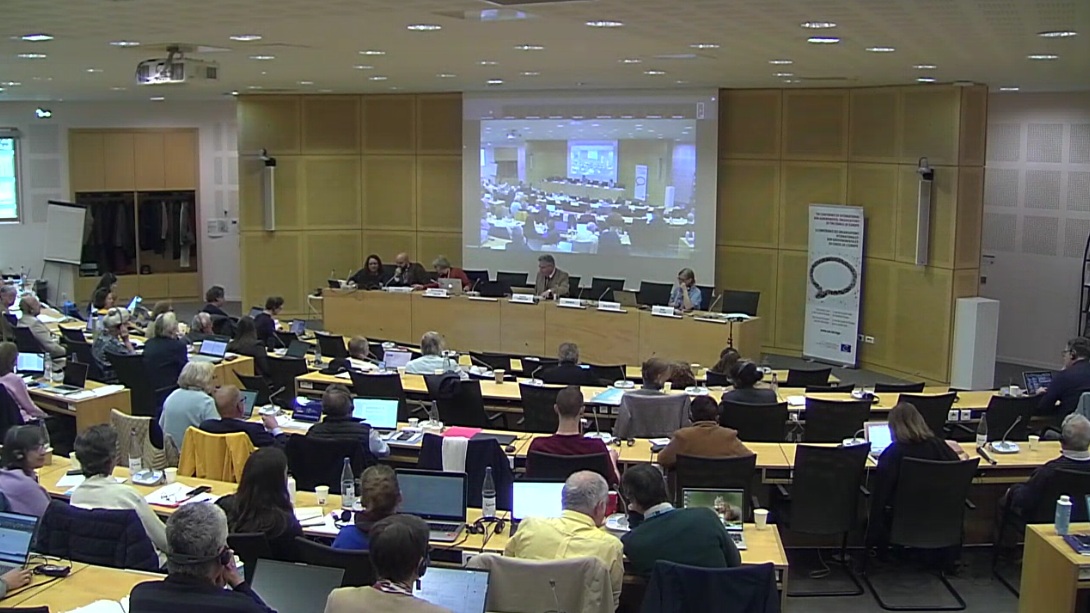
06.05.2026The Federal Union of European Nationalities (FUEN) attended the Spring General Assembly of the Council of Europe’s Conference of International NGOs (CINGOs). Held in a hybrid format from 14 to 17 April 2026, the General Assembly was attended online by former FUEN Vice-President and European Dialogue Forum member Gösta Toft, as well as Melek Kırmacı and Deniz Servantie from the Secretariat of the Working Group on Turkic Minorities (TAG).
CINGOs President Gerhard Ermischer presented the 2025 activity report at the opening of the General Assembly, highlighting strategic priorities including civil society, migration, artificial intelligence, and the environment. Ermischer emphasised that civil society must be a founding partner in building democracy and that youth participation is central to these processes.
Jeremy McBride, Chair of the Council of Europe’s Expert Committee on NGO Law, presented the Committee’s activities in 2025 and highlighted concerns that NGOs across Europe are being stigmatised and put under pressure through “foreign agent” laws and anti-money laundering legislation.
McBride also presented the report prepared by CINGOs following its visit to Greece from 12 to 14 November 2025. He sharply criticised the restrictions imposed by Greece’s civil society law and the failure to execute the European Court of Human Rights (ECtHR) judgments concerning minority associations of the Western Thrace Turks.
Speaking on the Greece report, Toft underlined that the ECtHR judgments in the Bekir-Ousta and Others group of cases have still not been executed and that FUEN hopes for their swift implementation.
Speaking as the second FUEN representative, Kırmacı noted that FUEN has eight member organisations in Greece, but that Greece discriminates even among these FUEN member organisations. While Macedonian and Turkish associations have been dissolved and new ones have not been permitted to be established, the Panhellenic Pomak Association, also a FUEN member, faced no issues during the registration process despite the word “Pomak” appearing in its name.
Kırmacı stressed that the ECtHR judgments concerning associations with the term “Turkish” in their names have not been executed for 18 years, as highlighted in the Bekir-Ousta and Others group of cases. She stated that the geopolitical justifications put forward by the Greek authorities, as noted in the CINGOs delegation’s report, constitute a legally flawed interpretation that violates democratic standards.
She also drew attention to the situation of Macedonian minority associations facing similar registration obstacles. Kırmacı recalled that FUEN member Krste Misirkov was registered, but that its registration was revoked by the Greek authorities three days later. The justification given was that the person who had submitted the association’s registration application had been mentioned in various cases within the Greek judicial system. Kırmacı noted that this serves as an example of the obstacles NGOs face during the registration process.
Responding to the comments on the Greece report, McBride explained that the primary responsibility for the failure to execute the ECtHR judgments lies not with the Court, but with the Committee of Ministers. As in the Bekir-Ousta and Others group of cases, he said, the Committee had made excessive concessions to the Greek authorities’ efforts to resolve the issues. McBride noted that the rejection or revocation of association registrations is clearly wrong and that these decisions must be reversed. He also added that the language used in the European Commission’s rule of law reports falls far short of adequately reflecting the issues. He underlined that without the Committee of Ministers adopting a tougher stance, no real change will occur.
PRESS RELEASES
- 8th Annual Meeting of the FUEN Working Group on Education: vocational education, minority languages and AI in focus
- FUEN discussed minority issues with EU institutions in Brussels
- FUEN exhibition opens at the European Parliament: putting minority languages on the European agenda
- FUEN Working Group on Education meets in Eupen: Focus on vocational education, minority languages and AI
- FUEN Assembly of Delegates 2026 calls for greater inclusion of minority languages in artificial intelligence
- FUEN Congress discusses geo-blocking and the protection of minority languages
- FUEN Congress Examines Mother-Tongue Access in Healthcare and Social Services
- FUEN Congress Spotlights the Future of Minority Languages in Public-Service Broadcasting
- 70th FUEN Congress opens in Helsinki/Helsingfors
- For Protection of the Cultural Identity: The Case of the Breton Community in France