










Members of the Croatian Community in Slovenia visited the German-Danish border region
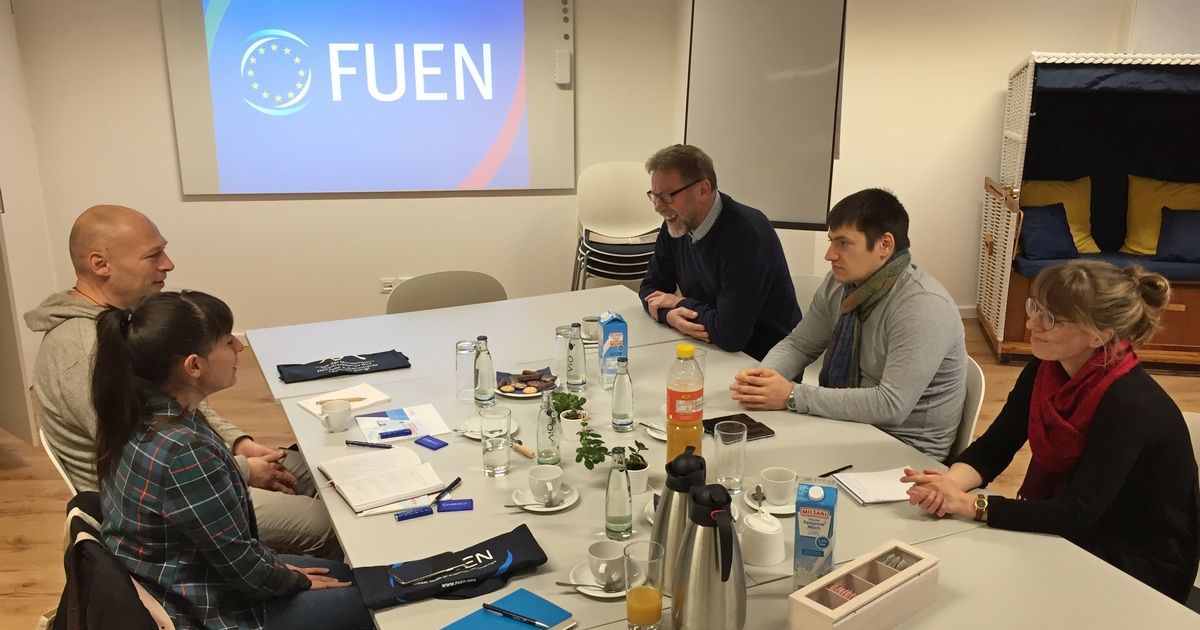
28.01.2019From 16th-18th January FUEN received a visit from the members of the Croatian Cultural Association Komušina from Slovenia within the framework of the ERASMUS+ Mobility Programme. The visit's main goal was to gain new knowledge and contacts from the German-Danish border region and to learn from best-practice exampleson how to encourage minority members to actively participate and engage in the local commmunities.
FUEN Vice-President GöstaToft welcomed them in the Kontor of the House of Minorities in Flensbug and introduced them the FUEN network and its activities. Based on the experiences of his own minority (Germans in Denmark) he explaind the long process of the conflict resolution between the Germans and the Danes that took place over the last 150 years in the border region. ”Reconciliation sometimes takes decades and its not advisable to force this process” Gösta Toft added. The current state of play of the Minority SafePack Initiative was also presented, together with the possibilities of further engagement within the FUEN activities.
Furthermore the group visited our neighbours from the European Centre for Minority Issues (ECMI) to gain an insight over their work and activities. It was mentioned that there are currently many projects going on (especially in the Ukraine), and the new toolkit for teaching diversity in schools and the ECMI Kosovo office were presented. The ECMI Summer School 2019 will take place in Berlin which could be a good opportunity for the guests to participate.
At the Europe Univesity Flensburg the visitors met with Prof. Dr. Nils Langer who is teaching the North-Frisian language, minority research and minority pedagogics. Mr. Langer presented how the Frisian language is part of the education for students who want to become teachers. The interest for Frisian language slightly increased in the last semester so they hope that the positive trend will continue.
On Friday the group traveled to Kiel to meet with the Office of the Minority Commissioner of Schleswig-Holstein Mr. Johannes Callsen. Ms. Linda Pieper gave an outlook of the minority protection policy of the state Schleswig-Holstein and their activities with the three recognised minorities in the state, Sinti and Roma, Frisian and Danish.
We would like to thank Komušina for their visit and to all the partners for their hospitality!
About Komušina :
It is a non – profit local minority organisation founded by individuals who believe in peaceful conflict resolution, intercultural dialogue and respect for human rights. Komušina uses activities aimed at creating and preserving open society, capable of critical thought and based on principles of equality, solidarity, human rights and the rule of law. Komušina also develops activities focusing on improving the status of minority members in the local community and closely cooperates with the Municipality of Škofja Loka. Key activities of Komušina are educational programmes for social inclusion of minority groups and employability of vulnerable groups, promotion of minority and migrant rights through culture and organising events to engage minorities in the local community.

PRESS RELEASES
- 8th Annual Meeting of the FUEN Working Group on Education: vocational education, minority languages and AI in focus
- FUEN discussed minority issues with EU institutions in Brussels
- FUEN exhibition opens at the European Parliament: putting minority languages on the European agenda
- FUEN Working Group on Education meets in Eupen: Focus on vocational education, minority languages and AI
- FUEN Assembly of Delegates 2026 calls for greater inclusion of minority languages in artificial intelligence
- FUEN Congress discusses geo-blocking and the protection of minority languages
- FUEN Congress Examines Mother-Tongue Access in Healthcare and Social Services
- FUEN Congress Spotlights the Future of Minority Languages in Public-Service Broadcasting
- 70th FUEN Congress opens in Helsinki/Helsingfors
- For Protection of the Cultural Identity: The Case of the Breton Community in France