












Initiative of the German youth in Poland for multilingual place-name signs
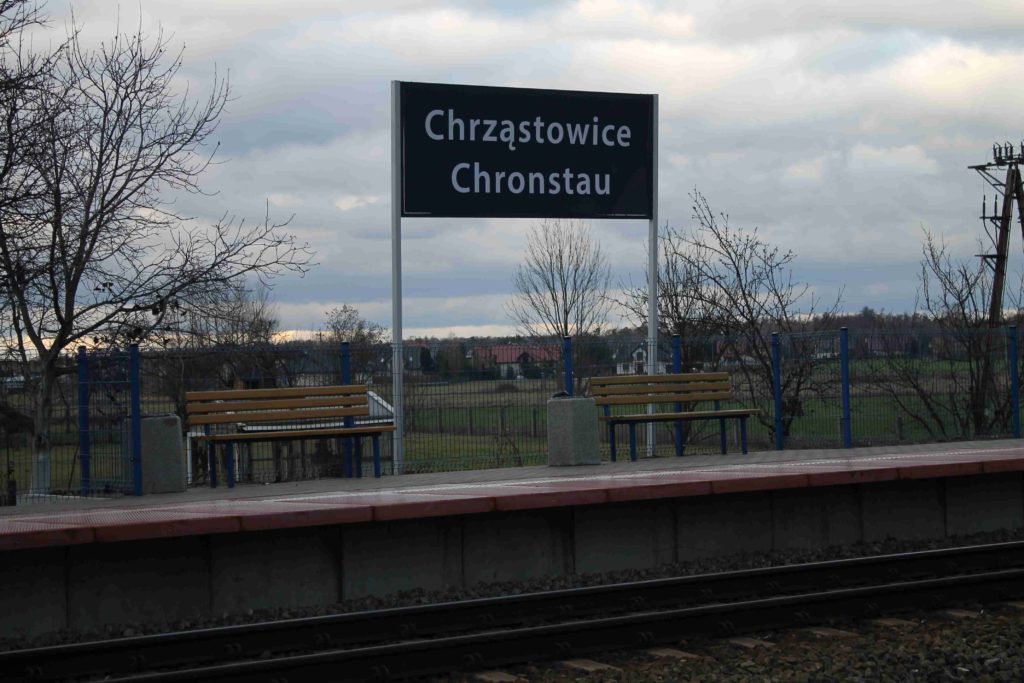
17.02.2021The Association of the Youth of the German Minority in Poland (BJDM) has launched the campaign #wPolsceusiebie #inPolendaheim #naszHeimat, with which it wants to send a media-effective signal for multilingual place-name signs in minority regions. As part of the initiative, the BJDM is asking minority communities in Europe to post photos of multilingual place-name signs using the hashtags mentioned above. FUEN supports this project and would like to ask you for your support.
The initiative is a response to the actions of Polish MP Janusz Kowalski, who questioned the legality of the bilingual place-name signs (Polish-German) at various railway stations in Opole last week. The MP from the ruling party and Vice Minister of State Assets published aquestion to the Minister of Infrastructure in which he allegedly points out that the erection of the signs is illegal. The question reveals that he wants the bilingual place-name signs at the railway stations in Opole to be taken down, as he sees them as a danger to Poland and claims that they were placed there illegally.
Rafał Bartek, chairman of the Social-Cultural Society of Germans in Opole Silesia, stresses to Wochenblatt, the weekly newspaper of the German minority in Poland, that the placement of the signs is legal. "The municipality consulted with the Ministry of the Interior for a long time to avoid any discrepancies. The decision of the Ministry of the Interior finally gave the municipality the right to apply the Minorities Act wherever a topographical designation appears."
Bernard Gaida, chairman of the Association of German Societies in Poland and AGDM spokesperson, points out in the same Wochenblatt article the connection between the incidents and the European Citizens' Initiative Minority SafePack. "It is the best proof that one has to work on the awareness of such people as Janusz Kowalski, who certainly likes the Polish name Cieszyn on the railway station in Český Těšín (Teschen), but cannot stand German names on railway stations in the part of Upper Silesia that lies in Poland. Equal European standards for national minorities are needed more than ever".
At a press conference organised by the Youth of the German Minority in Poland, the deputy chairperson of the BJDM, Zuzanna Herud, as quoted in the Wochenblatt, said: “Minority rights also serve us, young people, because we are the future of the minority and the region. So when someone says that it is dangerous to have bilingual signs at the railway stations in Chronstau and Dembiohammer, it is simply shocking for me to hear something like that. After all, we are at home here. The German minority will always live here and no one should call us dangerous just because of bilingual signs that are a symbol of our identity."
Photo: R. Urban via Wochenblatt
Пресс релизы
- 8th Annual Meeting of the FUEN Working Group on Education: vocational education, minority languages and AI in focus
- FUEN discussed minority issues with EU institutions in Brussels
- FUEN exhibition opens at the European Parliament: putting minority languages on the European agenda
- FUEN Working Group on Education meets in Eupen: Focus on vocational education, minority languages and AI
- FUEN Assembly of Delegates 2026 calls for greater inclusion of minority languages in artificial intelligence
- FUEN Congress discusses geo-blocking and the protection of minority languages
- FUEN Congress Examines Mother-Tongue Access in Healthcare and Social Services
- FUEN Congress Spotlights the Future of Minority Languages in Public-Service Broadcasting
- 70th FUEN Congress opens in Helsinki/Helsingfors
- For Protection of the Cultural Identity: The Case of the Breton Community in France