










Vincze Loránt: The human rights in the EU will remain truncated if they do not equally include minority rights
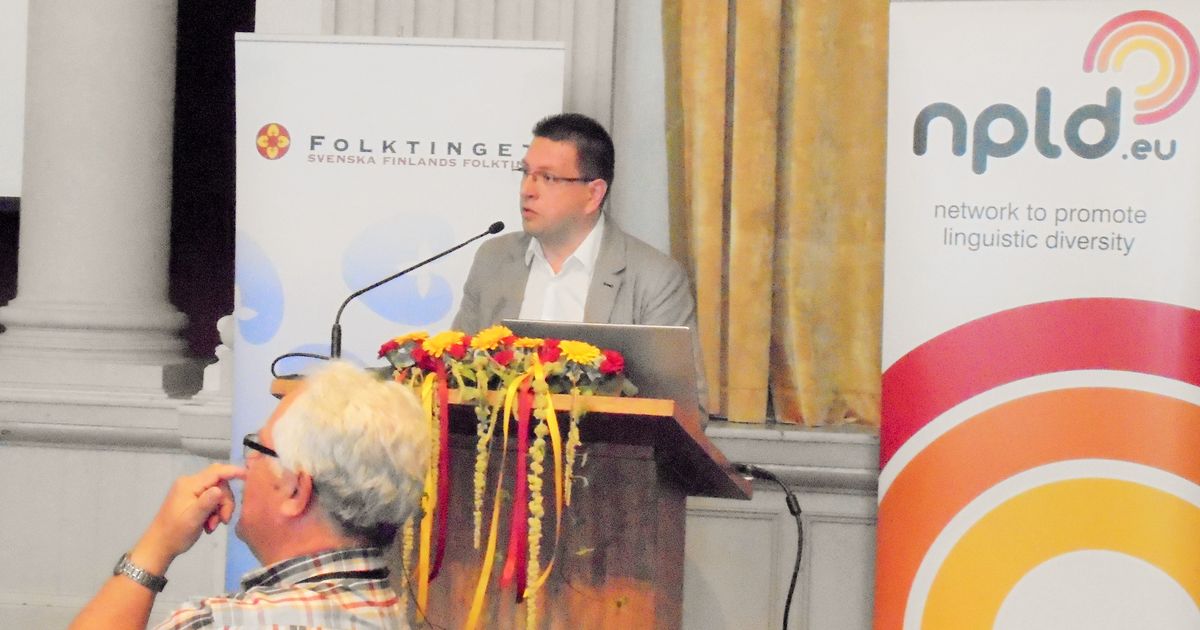
12.06.2015“We need to strengthen our minority solidarity, we have to point out together that having double standards in human rights and minority rights is not acceptable in the European Union. We consider that minority rights, language rights, language diversity is part of the basic human rights. There is no strong European Union and there are no strong European democracies without the protection of human rights, and human rights are truncated if they do not equally include minority rights.” – stated Loránt Vincze, FUEN Vice President and International Secretary of the Democratic Alliance of Hungarian in Romania, at the General Assembly of the Network to Promote Linguistic Diversity held in Helsinki on the 10-11 June.
He praised the support of the NPLD and its former president, Jannewietske de Vries for her personal commitment and valuable contribution as member of the Citizens Committee for the Minority SafePack Initiative (MSPI). The FUEN Vice President expressed his hope that the new leadership of the NPLD will continue to support the MSPI in the future. On behalf of the FUEN Loránt Vincze officially invited the NPLD to join the Advisory Council which will act as a think tank that will widen the perspectives of FUEN and other organisations and provide support for political implementation. “I am certain that as minority and language diversity organizations we need to combine our efforts to successfully represent the interests of our minorities in Brussels.” – stated the FUEN Vice President.
In his speech given at the NPLD Assembly Loránt Vincze made a comparison between the situation of the Swedish-speaking population in Finland and the Hungarian community in Romania, both representing the same proportion of the countries’ total population. The Swedish-speaking population has important legislative provisions enshrined in the Finnish Constitution, the country is bilingual, while in Romania the Hungarian language has no official status, not even in Transylvania, in the province where the Hungarians represent almost 20 percent of the population. The existing minority provisions are not fully implemented in Romania, the bilingual names are not always used, there are not enough public servants who know the Hungarian language, and the education law is not fully enforced. “Many minorities have disagreements with their government, but it is certainly a rare example to have an EU member state which does not apply its own legislation. And Romania is such an example.” – pointed out the FUEN Vice President at the General Assembly of the NPLD.
Пресс релизы
- 8th Annual Meeting of the FUEN Working Group on Education: vocational education, minority languages and AI in focus
- FUEN discussed minority issues with EU institutions in Brussels
- FUEN exhibition opens at the European Parliament: putting minority languages on the European agenda
- FUEN Working Group on Education meets in Eupen: Focus on vocational education, minority languages and AI
- FUEN Assembly of Delegates 2026 calls for greater inclusion of minority languages in artificial intelligence
- FUEN Congress discusses geo-blocking and the protection of minority languages
- FUEN Congress Examines Mother-Tongue Access in Healthcare and Social Services
- FUEN Congress Spotlights the Future of Minority Languages in Public-Service Broadcasting
- 70th FUEN Congress opens in Helsinki/Helsingfors
- For Protection of the Cultural Identity: The Case of the Breton Community in France