













Do You Speak Corona? Online is not the best option for the aging German community in Estonia
26.06.2020Until the end of May, fortunately none of the members of the Union of Germans in Estonia had fallen ill with coronavirus, although the association had already lost 3 of its oldest founding members at the beginning of the year – reported Ms Erika Weber, Chairperson of the Union.
In Estonia, the general situation is very difficult due to the underfunding. „The support provided by the Estonian state to minorities amounts to only 750 euros per year. The underfunding leads not only to a lack of events, but also to the decreasing number of members. Above all, youth work is very much at risk because many young people leave Estonia for existential reasons and settle in other countries such as England, Sweden or Austria”, explains Ms Weber. Nevertheless, Union tries, as far as possible, to organize meetings more often to celebrate the most important events and holidays together.
The pandemic made the situation even harder, as many members of the community have an advanced age, and they do not possess a computer or do not know how to use it. For this reason, online activities in the broadest sense cannot be carried out, and many members are still informed by mail.
How was official information disseminated to the minority communities in Estonia? We asked the Chair of the umbrella organization Estonian Union of National Minorities. Ms Natalia Ermakov explained to us that during the pandemic, they were supervised by the Ministry of Culture and the Integration Centre. All the information that the members of the minority organizations should have known was sent to her, as the head of the Estonian Union of National Minorities. She, in her turn, forwarded all the information in Estonian and Russian to the members of the organizations that are members of the Estonian Union of National Minorities.
A meeting with the Minister of Culture Tõnis Lucas, the Minister of Culture's assistant, professor Pirate Hartman, the head of the Integration Centre Irene Käosaar, and others also took place to discuss topics related to the pandemic and the nearest events. During the meeting, everyone could ask questions in different languages – Ms Ermakov told us.
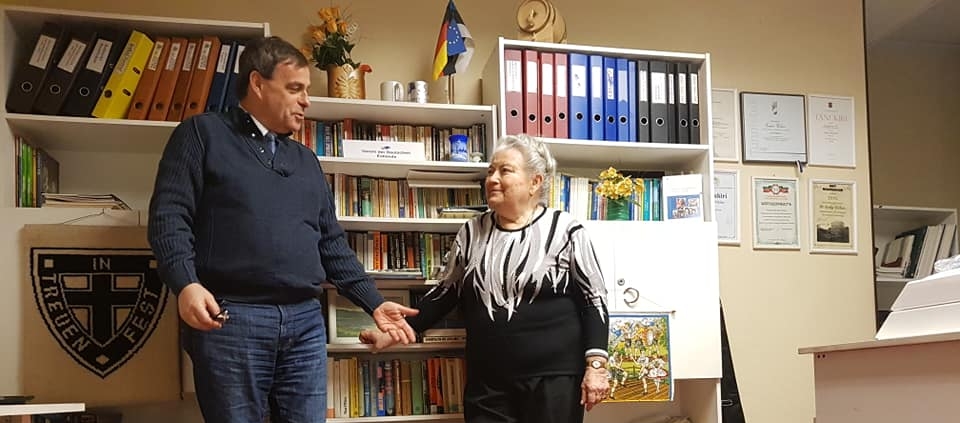
Pictured: AGDM Speaker Bernard Gaida on his visit to Ms Erika Weber. Photo credit: Bernard Gaida, AGDM
During April 2020 FUEN has conducted a survey entitled Do You Speak Corona? on the situation of European minorities during the pandemic. The online questionnaire focused on the availability of information related to COVID-19 in general, healthcare information related to the outbreak, the existence of an emergency hotline operated in minority language and the availability of online education in minority language. The short report on the results is here and you can download the whole report in PDF format by clicking here.
This series of case studies is the continuation of the Do You Speak Corona? project.
Пресс релизы
- 8th Annual Meeting of the FUEN Working Group on Education: vocational education, minority languages and AI in focus
- FUEN discussed minority issues with EU institutions in Brussels
- FUEN exhibition opens at the European Parliament: putting minority languages on the European agenda
- FUEN Working Group on Education meets in Eupen: Focus on vocational education, minority languages and AI
- FUEN Assembly of Delegates 2026 calls for greater inclusion of minority languages in artificial intelligence
- FUEN Congress discusses geo-blocking and the protection of minority languages
- FUEN Congress Examines Mother-Tongue Access in Healthcare and Social Services
- FUEN Congress Spotlights the Future of Minority Languages in Public-Service Broadcasting
- 70th FUEN Congress opens in Helsinki/Helsingfors
- For Protection of the Cultural Identity: The Case of the Breton Community in France